Prof A. Aldo Faisal
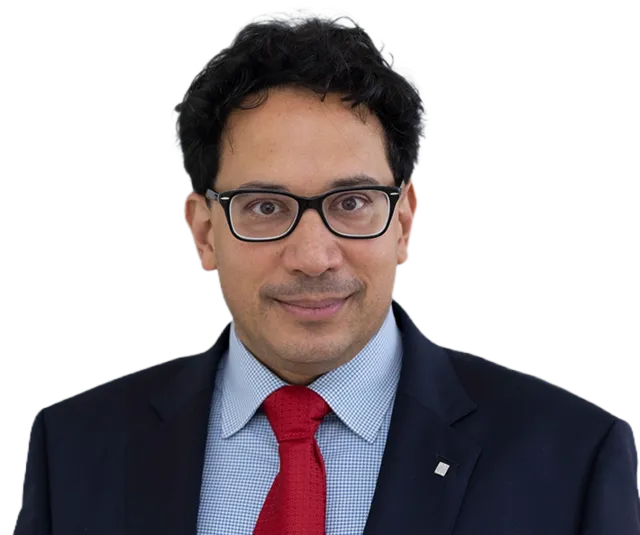
Professor & Director, UKRI Centers in AI for Healthcare
Affiliation: Imperial College London
Biography
Professor Aldo Faisal is the Professor of AI & Neuroscience at the Dept. of Computing and the Dept. of Bioengineering at Imperial College London. He was awarded a prestigious UKRI Turing AI Fellowship (£2 Mio including industry partners). Aldo is the Founding Director of the £20Mio. UKRI Centre for Doctoral Training in AI for Healthcare that aims to transform AI for Healthcare research and pioneer training 100 PhD and Clinical PhD Fellows. He also holds a Chair in Digital Health at the University of Bayreuth (Germany).At his two departments, Aldo leads the Brain & Behaviour Lab focussing on AI & Neuroscience and the Behaviour Analytics Lab at the Data Science Institute. He is Associate Investigator at the MRC London Institute of Medical Sciences and is affiliated faculty at the Gatsby Computational Neuroscience Unit (University College London). He was the first elected Speaker of the Cross-Faculty Network in Artificial Intelligence representing AI in College on behalf of over 200 academic members.
Aldo serves as an Associate Editor for Nature Scientific Data and PLOS Computational Biology and has acted as conference chair, program/area chair, chair in key conferences in the field (e.g. Neurotechnix, KDD, NIPS, IEEE BSN). In 2016 he was elected into the Global Futures Council of the World Economic Forum.
Aldo received a number of awards and distinctions, including Scholar of the German National Merit Foundation (Studienstiftung des Deutsche Volkes
Undergraduate & PhD), a PhD Fellow of the Böhringer-Ingelheim Foundation for Basic Biomedical Research, elections as a Junior Research Fellow at the University of Cambridge (Wolfson College), and a number of research prizes and award such as the Toyota Mobility Foundation $50,000 Research Discovery Prize in 2018, and together with the AI Clinician team the Rosetree Interdisciplinary Award (£300,000) in 2022.
Aldo's lab featured regularly across global media (such as BBC, CNN, TED, TEDx, Wall Street Journal, Guardian, Financial Times , WIRED, Scientific American, New Scientist, etc.), e.g. in 2016 Scientific American voted his research on gaze-based control as 1st of 10 most transformative ideas of year.
Dr Faisal's labs is operated as a borderless lab across UK and Germany. The UK lab at Imperial is located in the Royal School of Mines building and combine cross-disciplinary computational and experimental approaches to investigate how the brain and behaviour evolved to learn and control goal-directed behaviour. The neuroscientific findings enable the targeted development of novel technology for clinical and research applications (Neurotechnology) for a variety of neurological/motor disorders and amputees. Key techniques include on the computational side are data-driven methods from machine learning & stochastic modelling techniques and experimentally we use sensorimotor experiments, eye-tracking & kinematics (full-body, hands), non-invasive brain imaging (EEG, fNIRS), robotics (hand & arm robots).
Dr Faisal's Behaviour Analytics lab located in the Data Science Institute objective is the data-driven analysis of human behaviour and pioneering development of methods & algorithms to move in a principled manner from Big Data to Big Knowledge. Keys goals are, understand and predict human behaviour from ubiquitous sensors & digital data, predict and evaluate human performance, Infer internal or cognitive state (stress, risk) of individuals from behavioural dynamics, develop behavioural biomarkers of physiological and psychological well-being and bottom-up analysis of group and social dynamics from the decisions of individuals.
Biographical sketch: Aldo read Computer Science and Physics in Germany, where he wrote his Diplomarbeit (M.Sc. thesis) in non-linear dynamical systems and neural networks (with Helge Ritter). He moved on to study Biology at Cambridge University (Emmanuel College) and wrote his M.Phil. thesis on the electrophysiological and behavioural study of a complex motor behaviour in freely moving insects with Tom Matheson in the group of Malcolm Burrow FRS. For his Ph.D. he joined Simon Laughlin FRS group at the Zoology Department in Cambridge investigating the biophysical sources of neuronal variability. He was elected a Junior Research Fellow at Cambridge University (Wolfson College) and joined the Computational & Biological Learning Group (Engineering Department) to work with Daniel Wolpert FRS on human sensorimotor control. Between and after his studies he gained insights into strategic mangement consulting with McKinsey & Co. and as a "quant" with the investment bank Credit Suisse. In winter 2009 Aldo setup the Brain & Behaviour Lab at Imperial College to pursue a research program that aims at understanding the brain with principles from engineering which often immediately translates into direct technological applications for patients and society.